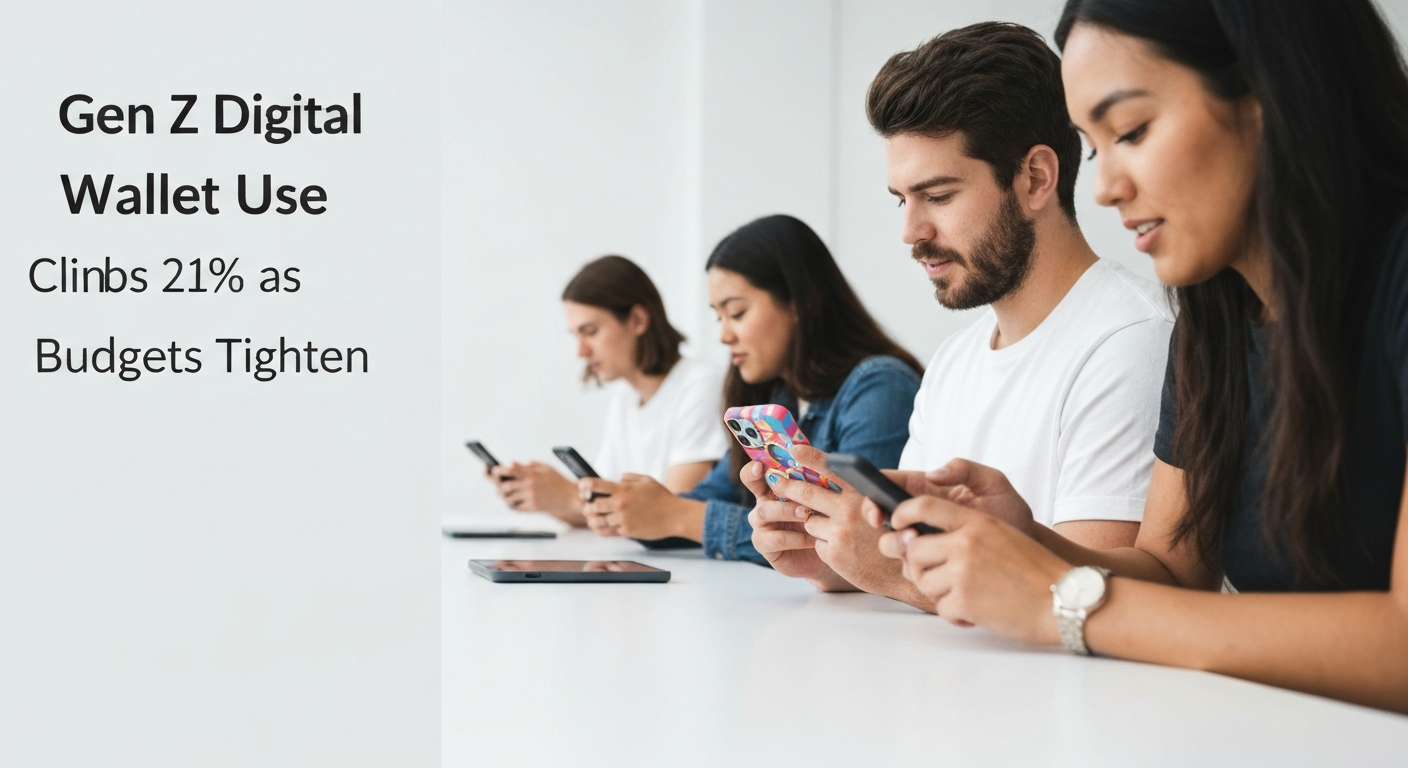
Gen Z's digital wallet usage has increased 21% year-over-year, with 78% of 18-26 year olds now using mobile payment apps as their primary transaction method — surpassing physical cards for the first time in any generational cohort. The acceleration is driven not by technology enthusiasm alone but by practical financial behavior: digital wallets provide real-time spending visibility, automated categorization, and integrated budgeting tools that help budget-constrained young adults manage limited income.
For the payments industry, this isn't a niche trend — it's the permanent future of consumer financial behavior that every merchant, bank, and fintech must accommodate or lose an entire generation of customers.
The Data Behind the Surge
PYMNTS' Connected Economy survey of 12,000 consumers reveals Gen Z payment patterns:
Primary payment method (Gen Z, ages 18-26):
- Digital wallet (Apple Pay, Google Pay, Samsung Pay): 44%
- Debit card (physical): 28%
- Cash App / Venmo (P2P apps used at merchants): 14%
- Credit card: 9%
- Cash: 5%
Year-over-year change:
- Digital wallet: +21%
- Debit card: -8%
- Cash App/P2P: +34%
- Credit card: -12%
- Cash: -18%
The credit card decline is particularly striking. Gen Z is actively choosing NOT to adopt credit cards — a break from every prior generation that adopted credit cards as soon as eligible. Only 36% of Gen Z adults hold a credit card (versus 68% of Millennials at the same age and 74% of Gen X).
Why Digital Wallets Win With Budget-Conscious Users
The 21% growth correlates with economic pressure. As inflation and housing costs compress Gen Z disposable income, this cohort gravitates toward payment tools that provide control and visibility:
Real-time balance awareness. Digital wallets show remaining balance after each transaction instantly. Credit cards show remaining credit limit (encourages spending); debit cards require checking a separate banking app. Wallets provide the "how much do I have left?" answer in the moment of purchase.
Automatic categorization. Apple Pay and Google Pay automatically tag transactions by merchant category. Users see "you spent $340 on food this week" without manually tracking — enabling passive budgeting that fits Gen Z's preference for effortless financial management.
BNPL integration. Digital wallets seamlessly offer buy-now-pay-later at checkout (Apple Pay Later, Affirm via Google Pay). For budget-constrained users, splitting a $200 purchase into 4 payments of $50 feels manageable in a way that $200 on a credit card (with 24% APR if not paid in full) does not.
P2P embedded. Splitting bills, paying rent to roommates, and settling group expenses happens within the same wallet ecosystem. Gen Z doesn't separate "paying a store" from "paying a friend" — both are tap-and-done through the same interface.
No credit score anxiety. Digital wallets linked to debit accounts don't affect credit scores, don't charge interest, and don't create debt. For a generation that witnessed parents' credit card struggles during 2008 and student loan crises, avoiding credit is a conscious financial philosophy — not a gap in financial literacy.
The Merchant Impact
The 78% digital wallet preference creates commercial pressure:
Transaction abandonment. 23% of Gen Z consumers report abandoning a purchase because the merchant didn't accept their preferred digital wallet. For a retailer with 30% Gen Z customer base, this represents measurable lost revenue.
Discovery through wallets. 31% of Gen Z discover new merchants through wallet-integrated offers, maps, and recommendations — making wallet presence a discovery channel, not just a payment acceptance channel.
Loyalty displacement. Traditional loyalty programs (physical cards, phone-number lookup) engage only 12% of Gen Z customers. Wallet-integrated loyalty (automatic reward accrual tied to payment method) engages 47%. Merchants without wallet-linked loyalty programs are invisible to this demographic's reward-seeking behavior.
Contactless expectation. 89% of Gen Z expects contactless payment acceptance as a minimum. Merchants with chip-only or swipe-only terminals are actively perceived as "outdated" — creating negative brand association that extends beyond the payment experience.
Why This Matters
For merchant payment strategy: If your customer base includes Gen Z (it does, increasingly), digital wallet acceptance is revenue-critical — not a nice-to-have. Evaluate: Apple Pay, Google Pay, Cash App Pay, Venmo QR at minimum. Budget for terminal upgrades if needed.
For banks targeting Gen Z: The traditional customer acquisition path (first credit card → checking account → long-term relationship) is broken for this generation. Banks must insert themselves into digital wallet ecosystems or accept that Cash App, Apple, and PayPal own the primary financial relationship.
For credit card issuers: Gen Z's 36% credit card adoption (versus 68% historical) represents a structural market shrinkage that won't recover generationally. Card networks must evolve from issuing physical products to becoming invisible infrastructure within digital wallets — or face permanent volume decline as Gen Z ages into peak spending years.
For BNPL providers: Digital wallet integration is the distribution strategy. BNPL products offered outside wallet checkout flows achieve 4% conversion; those integrated into Apple Pay or Google Pay achieve 18% conversion. The wallet IS the BNPL distribution channel for Gen Z.
For accounting firms: Gen Z entrepreneurs and freelancers manage business finances through digital wallets and P2P apps rather than traditional business banking. Firms serving young clients need to adapt: accepting digital payment for invoices, integrating with wallet transaction data for bookkeeping, and advising on tax implications of P2P business payments.
For financial literacy educators: Gen Z's budget-conscious wallet preference actually demonstrates strong financial behavior — choosing tools that provide visibility and control over tools that encourage debt. Reframe the narrative from "Gen Z doesn't use credit cards because they're financially illiterate" to "Gen Z avoids credit cards because they're financially cautious."
The key takeaway: Gen Z's 21% surge in digital wallet usage signals the permanent displacement of credit cards and cash as primary payment methods — merchants, banks, and fintechs that don't prioritize wallet-native experiences will lose access to 78% of transactions from the generation that will dominate consumer spending for the next 40 years.
Frequently Asked Questions
Why is Gen Z using digital wallets more than credit cards?
Which digital wallets are most popular with Gen Z?
How does Gen Z digital wallet adoption affect merchants?
Fintech.News Desk
Editorial TeamThe Fintech.News Desk covers tax and regulation, payments, accounting technology, and AI in finance. We run every story against one test — what does this change about money? — and combine AI-assisted research with editorial review.
Enjoyed this article?
Get stories like this first on our Telegram channel. Subscribed by thousands of fintech leaders.
Join us on TelegramRead Next
Embedded Payments Make Fraud Harder to See and Faster to Hit
Embedded payments hide fraud in plain sight. Learn how seamless integration impacts fraud detection & speed in fintech. Stay ahead of risks.
Inflation Hits 58% of Small Businesses and Pushes Embedded B2B Finance Forward
Inflation hurting SMBs? See how embedded B2B finance offers a lifeline. Discover solutions & strategies for accounting/fintech pros.

Fed Finds Stablecoins Idle, Confirms PYMNTS Usage Gap
Fed report reveals stablecoins mostly idle, used within crypto, not mainstream payments. PYMNTS usage gap confirmed. Fintech/accounting insights here.

68% of Banks Increase Fraud Defense Spending as Account Takeovers Spike
Banks boost fraud defense! 68% increase spending amid account takeover surge. Stay ahead of fintech security trends & protect your institution now.

BILL Expands Supplier Payments Plus Solution
Automate enterprise AP with BILL's Supplier Payments Plus. Enhanced features streamline supplier payments for large enterprises & SMBs. Learn more.
Visa Wants Fraudsters to Pick Another Business
Visa combats evolving fraud with AI. Deep dive into their strategy against sophisticated cybercrime. Insights for fintech & accounting pros.
More in this topic
HSBC Extends Tokenized Deposit Service to US Firms

Fed Rule Changes Would Expand SMB Lending Capacity
Trulioo Pushes Back Beyond One-Time Identity Checks
42% of CFOs Express Interest in Stablecoins as Payments Use Cases Grow
Gig Workers Want Real-Time Pay for Real-Time Work