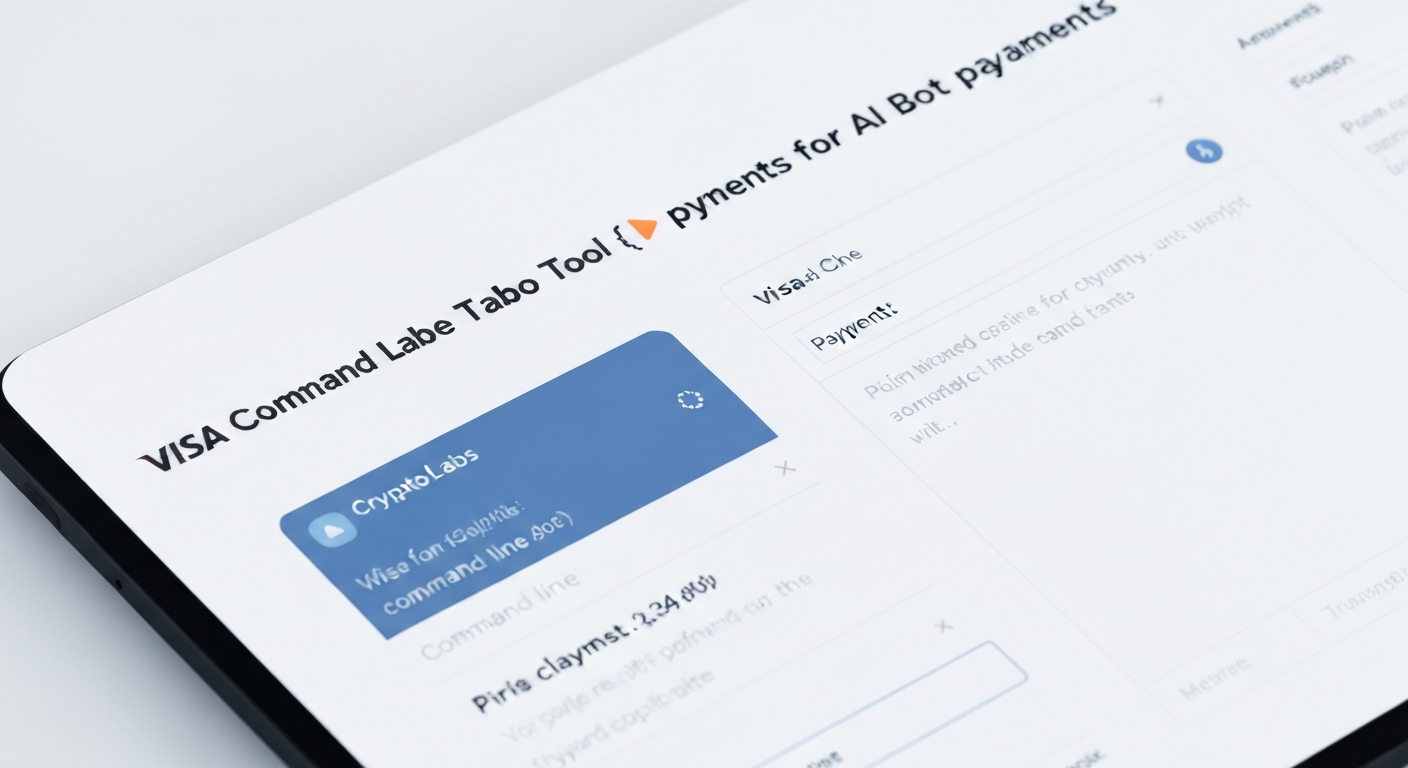
Visa Crypto Labs has released a command-line interface (CLI) tool that enables developers to provision AI agents with payment credentials in under 5 minutes — dramatically lowering the technical barrier to giving autonomous AI agents the ability to transact. The tool provisions a USDC wallet, configures spending limits and merchant allowlists, and generates machine-readable credentials that AI agents use to initiate and settle payments without human authentication.
For Visa, the CLI represents a critical strategic bet: rather than waiting for AI agent commerce to develop on alternative rails (stablecoins, ACH, open banking), Visa is inserting itself as the default payment infrastructure for the emerging machine economy — preserving network relevance in a world where AI agents, not humans, initiate the majority of transactions.
Technical Architecture
The developer workflow (5-minute setup):
$ visa-cli agent create --name "research-agent" \
  --budget 500 --currency USDC \
  --categories "cloud,data,api-services" \
  --require-approval-above 100

Agent created: agent_abc123
Wallet: 0x7a8b9c...
API Key: vk_live_...
Spending Rules: $500/week, auto-approve under $100
What this creates:
- A USDC wallet provisioned with the specified budget
- API credentials the AI agent uses to initiate payments
- Spending rules that Visa enforces programmatically (no per-transaction human approval)
- An audit trail of every agent transaction
- Real-time balance and transaction monitoring for the human owner
The payment flow:
- AI agent identifies a need (purchase API access, acquire data, pay for compute)
- Agent calls Visa API:
POST /v1/agents/agent_abc123/paymentswith: merchant, amount, purpose - Visa checks spending rules (is this within budget? allowed merchant? appropriate amount?)
- If approved: USDC transferred from agent wallet to merchant
- Confirmation returned to agent in <200ms
- Transaction logged: what was purchased, why (from agent's reasoning log), timestamp
Why Visa Built This
The competitive threat:
Without Visa-provided tools, AI agent payments flow through:
- Direct USDC transfers (bypasses Visa entirely)
- Stripe's Tempo protocol (Stripe captures the relationship)
- Embedded stablecoin wallets (crypto-native rails, no Visa involvement)
Each of these paths represents volume that never touches Visa's network — no interchange revenue, no data, no relationship. By providing the infrastructure that developers reach for first, Visa captures AI agent commerce before habits form around alternative solutions.
The "default rail" strategy:
When developers reach for a tool to give their AI agent payment capability, they'll choose whatever: (a) works immediately, (b) they already have credentials for, and (c) integrates with their existing stack. Visa's CLI advantages:
- Works immediately (5-minute setup)
- Credentials from existing Visa developer account
- Integrates with Stripe, AWS, and major cloud platforms
This "frictionless default" strategy is how payment infrastructure wins markets — not through superior technology but through being the easiest choice at the moment of first integration.
Spending Controls and Safety
The critical feature distinguishing Visa's tool from raw crypto wallets:
A USDC wallet given to an AI agent without controls provides: unlimited spending authority, no audit trail, no budget enforcement, and no ability to revoke mid-transaction.
Visa's controlled credentials provide:
- Budget envelopes: Weekly/monthly spending caps with automatic pause when exceeded
- Category restrictions: Agent can only purchase from approved merchant category codes
- Merchant allowlist: Only pre-approved vendors can receive payments
- Approval thresholds: Auto-approve under $50; notify owner above $50; require approval above $200
- Instant revocation: Owner can freeze credentials in <1 second
- Complete audit log: Every payment, with agent reasoning if provided
For enterprise AI deployments, these controls are the difference between "safe to deploy" and "liability risk too high to deploy." Visa's enterprise governance layer is what pure-crypto alternatives lack.
Market Positioning
| Tool | Approach | Strength | Limitation |
|---|---|---|---|
| Visa CLI | Controlled USDC via Visa infrastructure | Instant setup, governance controls, enterprise trust | Visa fees (0.5-1%), requires Visa relationship |
| Stripe Tempo | Open protocol, any payment method | Flexible, developer-friendly | Newer, less enterprise adoption |
| MetaMask SDK | Direct crypto wallet | Maximum control, lowest fees | Complex setup, no governance controls |
| Corporate cards (API) | Traditional card automation | Familiar, existing credit lines | Requires human auth, no AI-specific controls |
Visa's sweet spot: enterprise developers who need governance controls and trust the Visa brand — willing to pay Visa's margin for the compliance comfort.
Why This Matters
For enterprise developers building AI agents: Visa's CLI is the fastest path to giving your agent payment capability with enterprise-grade controls. If your organization already uses Visa Business Payments, the CLI integrates with existing compliance frameworks — reducing adoption friction significantly.
For CFOs and treasury teams: When your IT team asks permission to give AI agents payment authority, Visa's controlled credentials provide: budget caps that prevent runaway spending, merchant restrictions that prevent inappropriate purchases, instant revocation that provides emergency control, and audit trails that satisfy internal audit requirements. These controls make CFO approval achievable.
For Visa's competitors (Mastercard, American Express): Visa has first-mover advantage in AI agent payment infrastructure. Mastercard's equivalent program is 6-12 months behind. Amex's B2B corporate card infrastructure is enterprise-focused but not AI-agent-optimized. Time-to-market matters — developers adopting Visa CLI now will maintain it as habits and integrations form.
For payment infrastructure investors: The AI agent payment market represents a new category of transaction volume that flows through payment infrastructure without human involvement. Whoever captures this channel — Visa, Stripe, stablecoin issuers, or open banking — captures a structural growth driver independent of consumer spending cycles.
For accounting firms: Clients deploying AI agents with Visa payment credentials need internal control frameworks for: authorizing which agents get spending authority, setting appropriate budget limits, reviewing transaction logs regularly, and integrating agent spending into expense management systems (the transaction data format differs from corporate card data).
The key takeaway: Visa's 5-minute CLI for AI agent payments is a strategic first-mover bet that capturing developer habit-formation in AI commerce now will preserve Visa's network relevance as machine-to-machine transactions grow from $2B today toward $100B+ by 2030 — positioning the CLI as the path-of-least-resistance default before alternative rails cement their position.
Frequently Asked Questions
What does Visa's CLI tool enable for AI agents?
Why is Visa building tools for AI agent payments?
How does this differ from regular Visa API integration?
Fintech.News Desk
Editorial TeamThe Fintech.News Desk covers tax and regulation, payments, accounting technology, and AI in finance. We run every story against one test — what does this change about money? — and combine AI-assisted research with editorial review.
Enjoyed this article?
Get stories like this first on our Telegram channel. Subscribed by thousands of fintech leaders.
Join us on TelegramRead Next
AI Is Cracking Open Banking Before Quantum Gets the Chance
AI vs Quantum in Open Banking security: Discover how AI is revolutionizing cybersecurity for fintech & accounting, addressing threats before quantum computing.

Banks Face Complex Cyber Risks From Anthropic’s Mythos
Anthropic's Mythos AI poses complex cyber risks for banks. Learn how this tech impacts fraud, security, & compliance in fintech. Stay ahead of threats.

OpenAI has bought AI personal finance startup Hiro
OpenAI acquires Hiro! Explore the implications of this AI personal finance startup acquisition for fintech, accounting, and personalized financial advice.
How AI Is Rewriting Credit Decisioning in Real Time
AI is revolutionizing credit decisions! Learn how real-time data & AI algorithms are replacing static scorecards for faster, smarter risk assessment.
White House Tells Banks to Use Anthropic to Spot Vulnerabilities
White House urges banks like JPMorgan to test Anthropic's Mythos AI for vulnerability detection. Learn how this impacts fintech & accounting.

EY Rolls Out Agentic AI in Assurance Across Its Global Network of Accounting Firms
EY deploys agentic AI for assurance globally. Learn how this tech impacts audit efficiency, risk management, and the future of accounting.
More in this topic

Regulators Propose Audit-Ready Controls to Govern AI
Nvidia Partner Hon Hai’s Sales Meet Estimates on Solid AI Demand

Anthropic says Claude Code subscribers will need to pay extra for OpenClaw usage
Microsoft Pledges $5.5 Billion AI Investment in Singapore

Daylit Launches AI Agents for Automated Collections