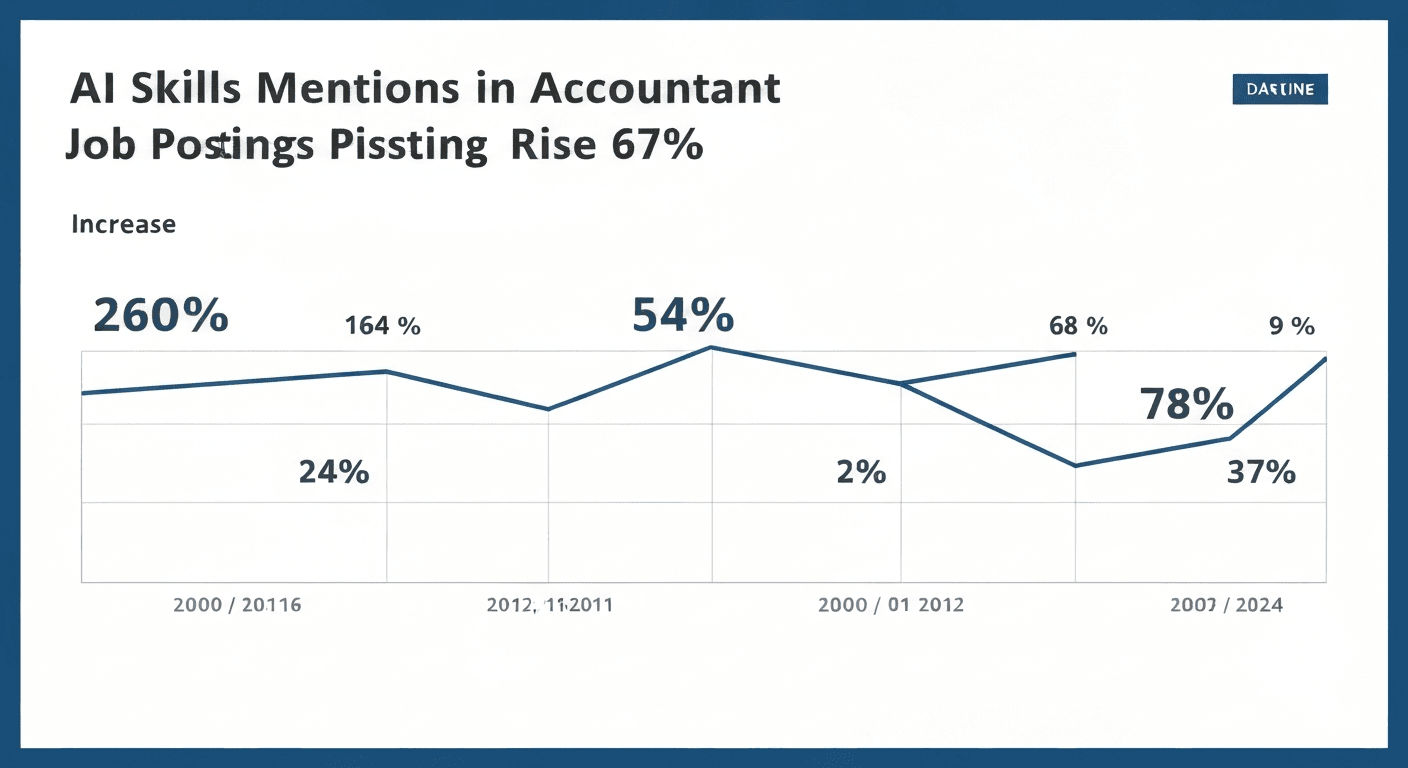
Accounting job postings mentioning artificial intelligence skills have increased 67% year-over-year, according to CPA Practice Advisor's analysis of 45,000 finance and accounting positions listed across major job platforms in Q1 2026. The surge represents the fastest acceleration in new skill requirements the profession has seen since spreadsheet software became mandatory in the 1990s.
The data signals an irreversible shift: AI fluency is transitioning from a competitive advantage to a baseline expectation for accounting professionals at every career level.
The Numbers Behind the Surge
The 67% increase isn't evenly distributed across the profession. Breaking down by role level reveals where demand is most acute:
- Staff accountant/associate: 82% increase in AI skill mentions
- Senior accountant/supervisor: 71% increase
- Manager/director: 58% increase
- Partner/principal: 38% increase
- Advisory/consulting: 74% increase
The most frequently requested AI-related skills in accounting postings:
- Data analysis and visualization (mentioned in 43% of AI-tagged postings)
- Experience with AI-powered accounting tools (38%) — specifically QuickBooks AI, Xero AI, and Copilot
- Prompt engineering and AI workflow design (27%)
- Understanding of machine learning outputs (24%)
- Python or R for data manipulation (19%)
- AI-assisted audit procedures (17%)
- Robotic process automation (RPA) (15%)
Notably, firms aren't asking accountants to build AI systems. They're asking accountants to use, evaluate, and manage AI outputs — a distinction that reshapes training priorities for the profession.
What's Driving the Demand
Three converging forces explain the acceleration:
Talent shortage math. The accounting profession faces a 340,000-person shortage by 2028 according to the AICPA. Firms can't hire enough humans, so they must make existing professionals more productive through AI augmentation. The 67% increase in AI requirements reflects firms building teams designed to produce more output per person.
Client expectations. Corporate finance departments now expect their accounting firms and internal teams to leverage AI. A Thomson Reuters survey shows that 61% of CFOs consider a firm's AI capability when selecting audit or advisory providers. Professionals who can't demonstrate AI fluency lose engagements.
Tool proliferation. The explosion of AI-embedded accounting tools means daily work increasingly involves AI interaction. When your general ledger auto-categorizes transactions, your audit software flags anomalies via machine learning, and your tax preparation system generates initial returns, AI literacy becomes as fundamental as Excel proficiency.
The Skills Gap Crisis
Despite surging demand, supply remains constrained. Only 12% of accounting programs at U.S. universities include AI-specific coursework. The AICPA's 2026 Competency Framework added "AI and Emerging Technology" as a required domain, but implementation across 4,000+ programs will take years.
The generational divide is stark. Professionals under 35 report 3.4x higher confidence in AI tools than those over 50, yet the latter group holds the decision-making authority for firm technology adoption. This creates a bottleneck where AI-ready junior staff lack authority and authority-holding seniors lack fluency.
Professional development spending on AI training has tripled since 2024, reaching $2,800 per professional annually at large firms. But most training remains introductory — "what is AI" rather than "how to validate AI outputs for audit evidence" or "how to design AI-augmented tax workflows."
Salary Premium and Career Impact
Professionals with demonstrated AI skills command measurable salary premiums:
- Staff level: 8-12% premium over non-AI-skilled peers
- Senior level: 12-18% premium
- Manager level: 15-22% premium
- Advisory/consulting: 20-30% premium for AI implementation specialization
Job security also correlates strongly with AI adoption. Robert Half's 2026 data shows that accounting professionals who actively use AI tools in their work report 67% lower anxiety about job displacement than those who haven't engaged with the technology — likely because engagement reveals that AI augments rather than replaces judgment-intensive work.
Why This Matters
The 67% surge isn't a temporary trend — it's the beginning of a permanent restructuring of professional competency expectations.
For practicing accountants: The window for voluntary upskilling is closing. Within 18-24 months, AI proficiency will shift from "preferred" to "required" in job postings at most firms. Professionals who invest in training now will be positioned as AI champions within their organizations; those who delay will face an increasingly competitive job market.
For firm leaders: Recruiting strategies must evolve. Competing for AI-literate talent against tech companies and fintechs requires competitive compensation, clear AI career paths, and genuine (not performative) technology investment. Firms that advertise AI requirements but don't provide tools and training will face credibility and retention challenges.
For educators: Accounting curricula must integrate AI not as a standalone elective but as a thread woven through audit, tax, advisory, and financial reporting courses. Teaching students to audit AI outputs is as critical as teaching them to audit manual processes.
For career changers: The AI skill premium in accounting creates an entry opportunity. Professionals from data science, engineering, or fintech backgrounds who obtain accounting credentials can command premium positioning at firms desperate for AI-fluent talent.
The key takeaway: The 67% surge in AI skill requirements transforms accounting hiring permanently — professionals who develop AI fluency in the next 12 months will command 15-30% salary premiums, while those who delay risk becoming unemployable in a profession that's automating its foundations.
Frequently Asked Questions
What AI skills are accounting firms looking for in 2026?
Do accountants need to learn to code to stay relevant?
Which accounting roles are most affected by AI skill requirements?
Fintech.News Desk
Editorial TeamThe Fintech.News Desk covers the latest developments in fintech, accounting technology, tax regulation, and AI in finance. We combine AI-assisted research with editorial review to deliver analytical news coverage for finance professionals.
Enjoyed this article?
Get stories like this first on our Telegram channel. Subscribed by thousands of fintech leaders.
Join us on TelegramRead Next
AI Is Cracking Open Banking Before Quantum Gets the Chance
AI vs Quantum in Open Banking security: Discover how AI is revolutionizing cybersecurity for fintech & accounting, addressing threats before quantum computing.

Banks Face Complex Cyber Risks From Anthropic’s Mythos
Anthropic's Mythos AI poses complex cyber risks for banks. Learn how this tech impacts fraud, security, & compliance in fintech. Stay ahead of threats.

OpenAI has bought AI personal finance startup Hiro
OpenAI acquires Hiro! Explore the implications of this AI personal finance startup acquisition for fintech, accounting, and personalized financial advice.
How AI Is Rewriting Credit Decisioning in Real Time
AI is revolutionizing credit decisions! Learn how real-time data & AI algorithms are replacing static scorecards for faster, smarter risk assessment.

White House Tells Banks to Use Anthropic to Spot Vulnerabilities
White House urges banks like JPMorgan to test Anthropic's Mythos AI for vulnerability detection. Learn how this impacts fintech & accounting.

EY Rolls Out Agentic AI in Assurance Across Its Global Network of Accounting Firms
EY deploys agentic AI for assurance globally. Learn how this tech impacts audit efficiency, risk management, and the future of accounting.
More in this topic
Regulators Propose Audit-Ready Controls to Govern AI
Nvidia Partner Hon Hai’s Sales Meet Estimates on Solid AI Demand

Anthropic says Claude Code subscribers will need to pay extra for OpenClaw usage

Microsoft Pledges $5.5 Billion AI Investment in Singapore
Daylit Launches AI Agents for Automated Collections