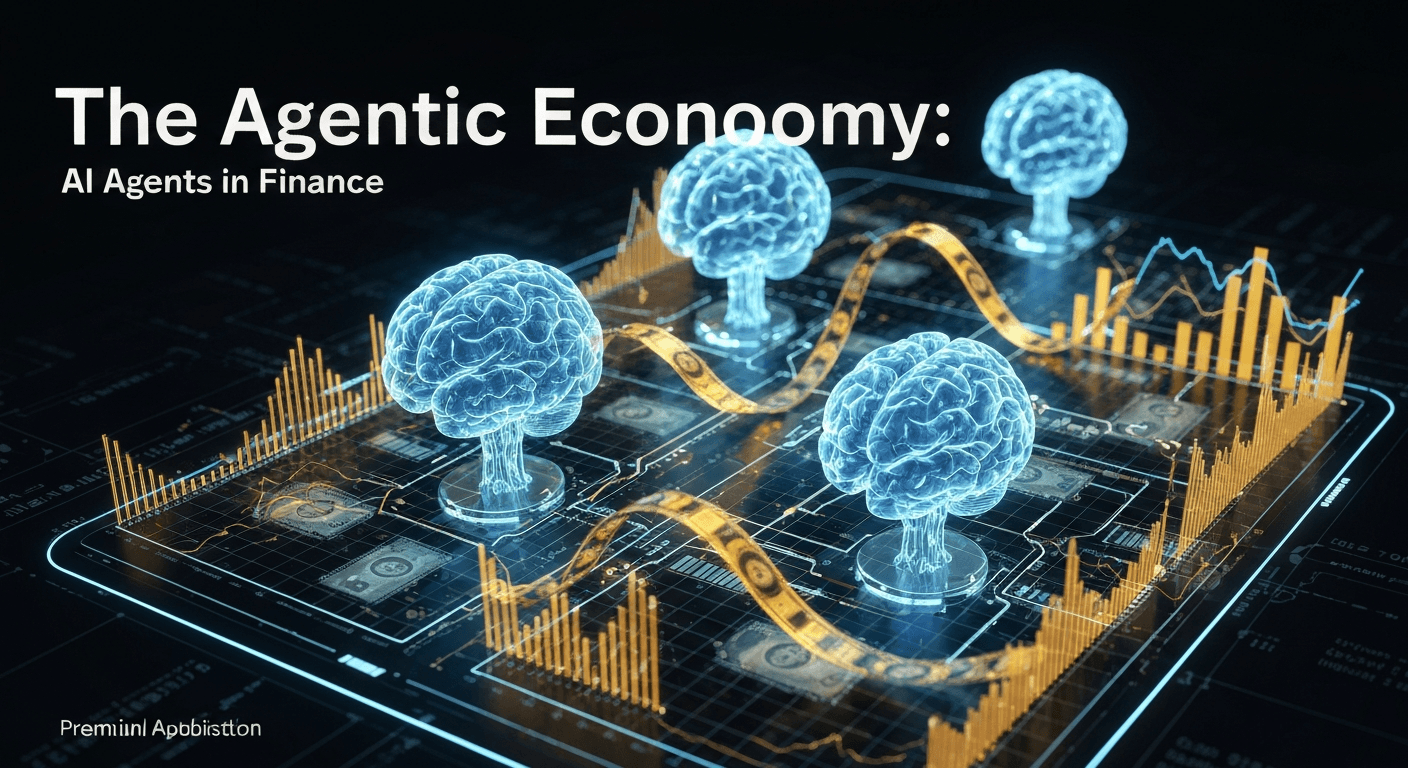
The Agentic Economy: How AI Agents are Redefining Financial Autonomy (2026 Edition)
In the early 2020s, AI was a tool for communication. In 2026, AI is a tool for execution. We have officially entered the "Agentic Economy"—a paradigm where autonomous software agents are no longer just chatbots giving advice, but financial actors with their own wallets, credit limits, and legal standing.
For the modern SMB owner or financial professional, the shift from "Human-to-Human" to "Human-to-Agent" (and even "Agent-to-Agent") transactions is the single most important development in the history of digital finance. This guide explores the architecture of this new economy and the compliance hurdles you must navigate to survive it.
Insert Internal Link: Why Mastercard’s $1.8B acquisition of BVNK is the infrastructure play the Agentic Economy needed
1. Defining the AI Agent as a "Financial Principal"
Historically, software was a "tool" used by a "user." The responsibility—and the financial liability—rested entirely with the human clicking the button. In the Agentic Economy, this boundary is blurring.
An AI Agent is an autonomous entity capable of:
- Holding Assets: Managing self-sovereign wallets or corporate sub-accounts.
- Executing Contracts: Triggering smart contracts or signing multi-sig transactions based on pre-set parameters.
- Negotiating Terms: Engaging in real-time "bidding wars" with other agents for resources like cloud computing, energy, or liquidity.
The Shift from "Approval-Based" to "Outcome-Based" Finance
In traditional fintech, you approve a transaction. In agentic finance, you approve an objective. For example, an SMB owner might tell their Agent, "Maintain a $50,000 liquidity buffer in our USDC account and optimize the remaining $10,000 across the top three DeFi yield protocols with an 'A' risk rating." The Agent then executes hundreds of transactions over weeks without a single human "OK."
2. Autonomous Treasury Management for SMBs
For small businesses, the primary benefit of the Agentic Economy is the democratization of sophisticated treasury management. Previously, only Fortune 500 companies had the headcount to manage complex yield-optimization strategies.
Bridging the Gap: The "Virtual CFO"
AI Agents now act as virtual CFOs that never sleep. They can:
- Arbitrage Settlement Windows: Automatically move funds between bank accounts to capitalize on faster settlement rails (e.g., FedNow vs. SEPA Instant).
- Tax-Loss Harvesting: Real-time monitoring of digital asset holdings to "lock in" losses for tax offsets without losing market position.
- Real-Time Payroll: Abandoning the "bi-weekly" pay cycle in favor of streaming micropayments directly to employees' wallets as work is completed.
| Feature | Legacy Fintech | Agentic economy |
|---|---|---|
| Pace of Operation | Human-Led (9-to-5) | 24/7 Autonomous |
| Decision Logic | Rules-Based (If-This-Then-That) | Goal-Oriented (Reinforcement Learning) |
| Execution | Manual Confirmation | Zero-Click Autonomy |
3. The Compliance Challenge: KYC for Machines
The most significant hurdle for the Agentic Economy is the Machine Know Your Customer (mKYC) protocol. Anti-Money Laundering (AML) laws were written for humans. When a machine opens an account, who is the "Ultimate Beneficial Owner" (UBO)?
The Regulatory Landscape in 2026
Regulators are increasingly requiring that every AI Agent be mapped to a human or corporate "Principal." This ensures that if an Agent "goes rogue" and executes an illegal transaction, there is a physical entity to hold liable.
Compliance Checklist for Agentic Workflows:
- Agent Identity (DID): Does your agent have a Decentralized Identifier that links to your corporate tax ID?
- Liability Buffer: Have you set hard spending limits on the agent’s wallet to prevent algorithmic runaway?
- Audit Trail: Is your agent’s "thought process" (its prompt logs and decision trees) being archived in an immutable, audit-ready format?
Insert Internal Link: The Ultimate Guide to Crypto Tax Compliance for Small Businesses (2026 Edition)
4. Algorithmic Credit: The New Underwriting Frontier
In 2026, AI Agents aren't just spending money; they are borrowing it. Traditional credit scores (FICO) are being supplemented by "Algorithmic Reputation Scores."
Credit for Agents
Imagine an AI Agent running an automated e-commerce store. It needs a line of credit to buy inventory for a flash sale. Instead of a bank looking at the owner’s credit, the lender’s AI Agent analyzes the store agent’s historical conversion rates, inventory turnover, and wallet health.
This leads to "Flash Credit"—loans that exist for only minutes or hours, settled entirely by code. For SMBs, this provides unprecedented flexibility in managing seasonal cash flow gaps.
5. Auditability: Why CPAs Must Become Algorithm Auditors
As AI Agents take over the day-to-day movement of funds, the role of the accountant is shifting from "bookkeeper" to "integrity officer."
The Real-Time Audit
CPAs must now perform "Code Audits" rather than just "Statement Audits." They need to verify that the logic governing an Agent meets GAAP (Generally Accepted Accounting Principles).
Key Questions for Accountants in 2026:
- "Did the Agent’s algorithm correctly categorize the 'gas fees' as deductible business expenses?"
- "Was the 'slippage' on that cross-chain swap within the company’s risk policy?"
- "Does the Agent’s decision-making log provide enough 'contemporaneous documentation' to satisfy an IRS audit?"
The Future: A "Self-Driving" Financial System
The Agentic Economy is the final step in the maturity of fintech. We moved from paper to digital, and now from digital to autonomous. While the risks of "black swan" algorithmic failures are real, the efficiency gains for SMBs—which can now operate with the financial sophistication of a global bank—are too significant to ignore.
As a finance professional, your value is no longer in what you do, but in the logic you define for the agents that do it for you.
Join the Conversation
Is your business ready to give an AI Agent its own wallet? Or are the risks of autonomous finance still too high for comfort? How are you preparing your accounting workflows for the "Shift to Agentic"?
Share your thoughts in the comments below!
Stay Ahead of the Curve: Subscribe to the Fintech.News Weekly Roundup for exclusive deep-dives on the Agentic Economy, or join 5,000+ members in our Telegram Channel for real-time alerts.
Fintech.News Desk
Editorial TeamThe Fintech.News Desk covers the latest developments in fintech, accounting technology, tax regulation, and AI in finance. We combine AI-assisted research with editorial review to deliver analytical news coverage for finance professionals.
Enjoyed this article?
Get stories like this first on our Telegram channel. Subscribed by thousands of fintech leaders.
Join us on TelegramRead Next
Microsoft Pledges $5.5 Billion AI Investment in Singapore
Microsoft invests $5.5B in Singapore AI. Learn how this move impacts fintech & accounting, plus what it means for Southeast Asia's tech landscape.
Daylit Launches AI Agents for Automated Collections
Daylit's AI agents automate collections, easing cash flow pressures. Learn how this fintech innovation can optimize your accounting processes and improve ROI.

AI Schism Grips Washington as Tech, Labor Vie for Upper Hand
Washington splits on AI regulation as tech giants lobby for self-governance while labor unions push mandatory disclosure and job displacement protections.
Goldman’s New Adviser Rishi Sunak Urges Small Firms to Adopt AI
Goldman Sachs advisor Rishi Sunak pushes AI adoption for SMEs. Discover how AI solutions are now essential for accounting & fintech success.
MindBridge Unveils Developer Portal to Support Continuous Financial Oversight
MindBridge's new developer portal empowers fintech & accounting pros with tools for continuous financial oversight. Enhance efficiency & accuracy now.

Gartner Says CFOs Need to Rethink the ROI of AI Investments
CFOs: Rethink AI ROI. Gartner urges finance leaders to reassess AI investments for accurate ROI. Unlock value & avoid pitfalls. #AIinFinance #CFO #Gartner
More in this topic
AI Is Cracking Open Banking Before Quantum Gets the Chance

Banks Face Complex Cyber Risks From Anthropic’s Mythos

OpenAI has bought AI personal finance startup Hiro
How AI Is Rewriting Credit Decisioning in Real Time
White House Tells Banks to Use Anthropic to Spot Vulnerabilities
EY Rolls Out Agentic AI in Assurance Across Its Global Network of Accounting Firms
Regulators Propose Audit-Ready Controls to Govern AI
Nvidia Partner Hon Hai’s Sales Meet Estimates on Solid AI Demand